All Categories
Featured
Future Middle East Market Trends for 2026 Global Markets
Building Sustainable Financial Portfolios with GCC Securi...

Ways to Leverage International Capital Potential in 2026
Positioning Middle East Portfolios for 2026 Shifts
Table of Contents
Home costs have come under pressure after a period of strong development, with recent data from the Dubai Land Department showing a drop in home mortgage transactions and money sales. Nonetheless, we think the threat of a long lasting migrant outflow and an extreme slump in the genuine estate sector is low.
As a long lasting US-Iran deal takes shape, the fallout from the conflict has tightened regional monetary conditions, exposing vulnerabilities through capital outflows, wider bond spreads, and weaker financier sentiment. The majority of GCC sovereigns carry relatively little debt and funding risks are for that reason restricted in the UAE, the main bank's liquidity management has actually alleviated instant concerns.
That said, Bahrain has been able to rely on assistance from neighbours, including Saudi Arabia and the UAE, and it effectively raised $1bn from an oversubscribed sovereign bond sale this month, marking the very first offering from the area given that the war started. High-frequency fiscal information underscore the stress on local public financial resources from the conflict.
Analyzing Regional Market Potential in 2026
In Saudi Arabia, the budget deficit more than doubled to SAR125.7 bn, or about 9% of GDP in Q1, driven by a decline in oil profits and a rise in spending, especially on aids, reflecting contingency expenses tied to the regional environment and a velocity of Vision 2030 costs. In Qatar, the crisis brought oil and gas revenue to a halt, swelling the budget plan deficit to the biggest since 2017.
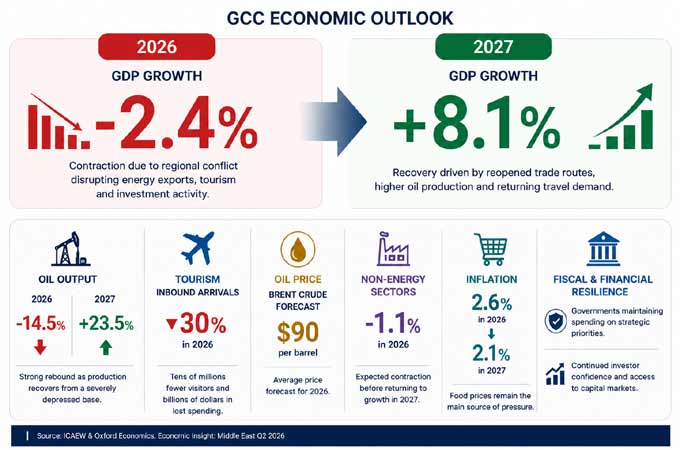
GCC inflation characteristics stay unequal, with food rates the main source of upward pressure and inflation in this category fortifying in Kuwait, Oman and Qatar. By contrast, food inflation stays fairly controlled in Saudi Arabia, most likely reflecting the mitigating result of its bigger domestic food production base and higher supply-chain strength.
We continue to view rate pressures as mainly temporal instead of a sign of a continual inflationary cycle. Appropriately, we expect average inflation to relieve to 2.1% y/y in 2027 as short-lived supply-side pressures dissipate. With near-term inflation elevated and transit through the Strait most likely set to resume gradually, we anticipate the United States Federal Reserve to keep interest rates on hold up until December, and local rate policies to follow fit.
We expect Iran's GDP to shrink by 10.8% this year (we anticipate a 9.4% contraction three months ago). Oil production and exports, which offer vital income and FX inflows, have been cut by the US marine blockade, while non-oil activity has been badly hit. In Iraq, oil exports have actually collapsed to a trickle and we're forecasting GDP to agreement by around 22% this year, with a sharp 33% rebound in 2027 as oil exports normalise.
By contrast, Syria continues to reintegrate into the worldwide economy after more than a years of civil war. We expect GDP development to typical 9.6% over 2026-2027, supported by restored investment, especially in banking and energy, financial reforms, and the steady reopening of regional trade links.
Middle East Equity Market Patterns in 2026
The World Bank has slashed its 2026 growth projection for Middle East economies, stating general GDP growth in the region is anticipated to slow from an estimated 3.6% in January to 1.8% for 2026. The closure of the strategic Strait of Hormuz, and damage of energy and public facilities, had actually disrupted markets, increased financial volatility, and damaged the 2026 growth outlook, the World Bank Group said in its Economic Update for the Middle East, North Africa, Afghanistan and Pakistan.
The April 2026 World Bank's Macro Poverty Outlook anticipates that the area's aggregate (leaving out the Iran) GDP development will slow down to 1.8 percent in 2026, down from 4.0 percent estimated for 2025. The 2026 projection has actually been reduced by 2.4 portion points given that the January forecasts, reflecting the unfavorable effects of the continuous dispute.
Saudi Arabia: Forecast was devalued by 1.2 percentage points given that January. Development is now expected to slow from 4.3% in 2025 to 3.1% in 2026, keeping in mind that Saudi Arabia's outlook remains the strongest among Gulf economies. United Arab Emirates: Development projection for the UAE has fallen by 2.7 percentage points because January.
Qatar: Especially, development projection for the Qatari economy has seen a sharp decline of 11.0 portion points considering that January. The economy is now anticipated to tape a contraction of 5.7%, down from an estimated growth of 5.3%, due to extreme blockage to melted gas materials. Qatar is a key player in the international energy market, with a worldwide market share of melted natural gas (LNG) materials varying in between 20% and 21%.
Kuwait relies entirely (100%) on the Strait of Hormuz to export its petroleum and derivatives. Consequently, closing the strait would imply a total shutdown of the nation's financial lifeline, immediately stopping profits inflows to the state budget plan. Bahrain: Growth projection for Bahrain's economy has declined by 1.8 percentage points since January.

Latest Posts
Benefits of Diversified Capital Allocation in 2026

Future Middle East Market Trends for 2026 Global Markets

Building Sustainable Financial Portfolios with GCC Securities